There’s a review of a famous Busan gukbap restaurant that says the soup was bland and tasteless, and that the writer doesn’t understand what people rave about.
They weren’t wrong about the taste. They just weren’t told the part that everyone in Busan already knows: the bowl arrives unfinished on purpose. Seasoning it is your job, and there’s a tray on the table to do it with.
Get that one thing right and dwaeji gukbap goes from disappointing to the meal you think about after you fly home. 🍲
🍲 What it actually is
Pork bone broth, simmered long enough to go cloudy and white. Sliced boiled pork. A bowl of rice, either already in the soup or served alongside so you can tip it in yourself.
That’s the whole dish. No chilli in the pot, no strong aromatics, nothing loud. It’s the kind of food that exists because someone needed to feed a lot of people cheaply and warmly, which is exactly how it started.
Busan filled with refugees during the Korean War, pork bones were what you could get, and the soup that came out of that has been the city’s default meal ever since. People eat it for breakfast. They eat it at 3am. There are shops that have never closed since the 1940s.
Why Busan and not Seoul
You can find gukbap across Korea, but Busan’s version is its own thing and locals are firm about it. The broth here is lighter and cleaner than the northern styles, and the seasoning-at-the-table habit is stronger. Ask someone from Busan about their gukbap shop and you’ll get a longer answer than you wanted.
🧂 The seasoning tray (read this part)
Every table has a small collection of jars and bottles. This is the actual dish. Here’s what’s in front of you and what each one does:
| What it is | Korean | What it does | How much |
|---|---|---|---|
| Salted shrimp | 새우젓 | The main seasoning. Salty and slightly funky. This is what most locals reach for first. | Half a teaspoon, stir, taste. It is very salty. |
| Red seasoning paste | 다대기 / 양념장 | Chilli heat and colour. The dish has none until you add this. | Start with a small dab. You can always add more. |
| Fermented soybean paste | 된장 | Depth and a darker, savoury note. Not every shop puts it out. | A small spoonful. |
| Salt and black pepper | 소금 / 후추 | Plain adjustment if you’d rather not use the shrimp. | To taste. |
| Chopped chives | 부추 | Freshness and a bit of bite. Usually a whole bowl of it. | A generous handful. Don’t be shy. |
| Raw garlic | 마늘 | Sliced, sometimes with green chilli next to it. | Optional. Strong. |
The order to do it in
- Taste the broth first, before you add anything. You want to know the baseline.
- Add the chives. All of them, more or less.
- Add salted shrimp a little at a time, stirring and tasting between each go.
- Add red paste if you want heat. This is a choice, not a requirement.
- Tip the rice in, if it came separately.
Two minutes of work. It’s the difference between a bland bowl and the reason the shop has been open since 1946. 🥄
If you only remember one word from this page, make it 새우젓 (saeujeot), the salted shrimp. That’s the one that fixes the bowl.
🥄 Rice in the soup, or rice on the side?
Both are correct and shops do it differently, so you may get either without being asked.
- 국밥 (gukbap) means the rice is already in the bowl, sitting under the soup.
- 따로국밥 (ttaro gukbap) means “separately” and the rice comes in its own bowl.
If it arrives separately, most people tip the whole thing in. Some eat a spoonful of rice, then a spoonful of soup, keeping the rice from going soft. Neither is wrong.
What you shouldn’t do is leave the rice untouched and only drink the broth. The dish is built as one thing, and the rice is what makes it a meal rather than a starter.
Spoon or chopsticks
Spoon for the soup and rice. Chopsticks for the pork, the kimchi, and the chives. You’ll have both. Koreans switch between them constantly and nobody is counting.
The pork slices are meant to be dipped in the red seasoning paste on the side, not just eaten from the broth. Try one both ways.
📋 How to order without getting a surprise
Most gukbap shops sell five or six variations of the same soup, and the difference is what’s in it. This is where visitors get caught out, because the menu is usually Korean only and the words look similar.
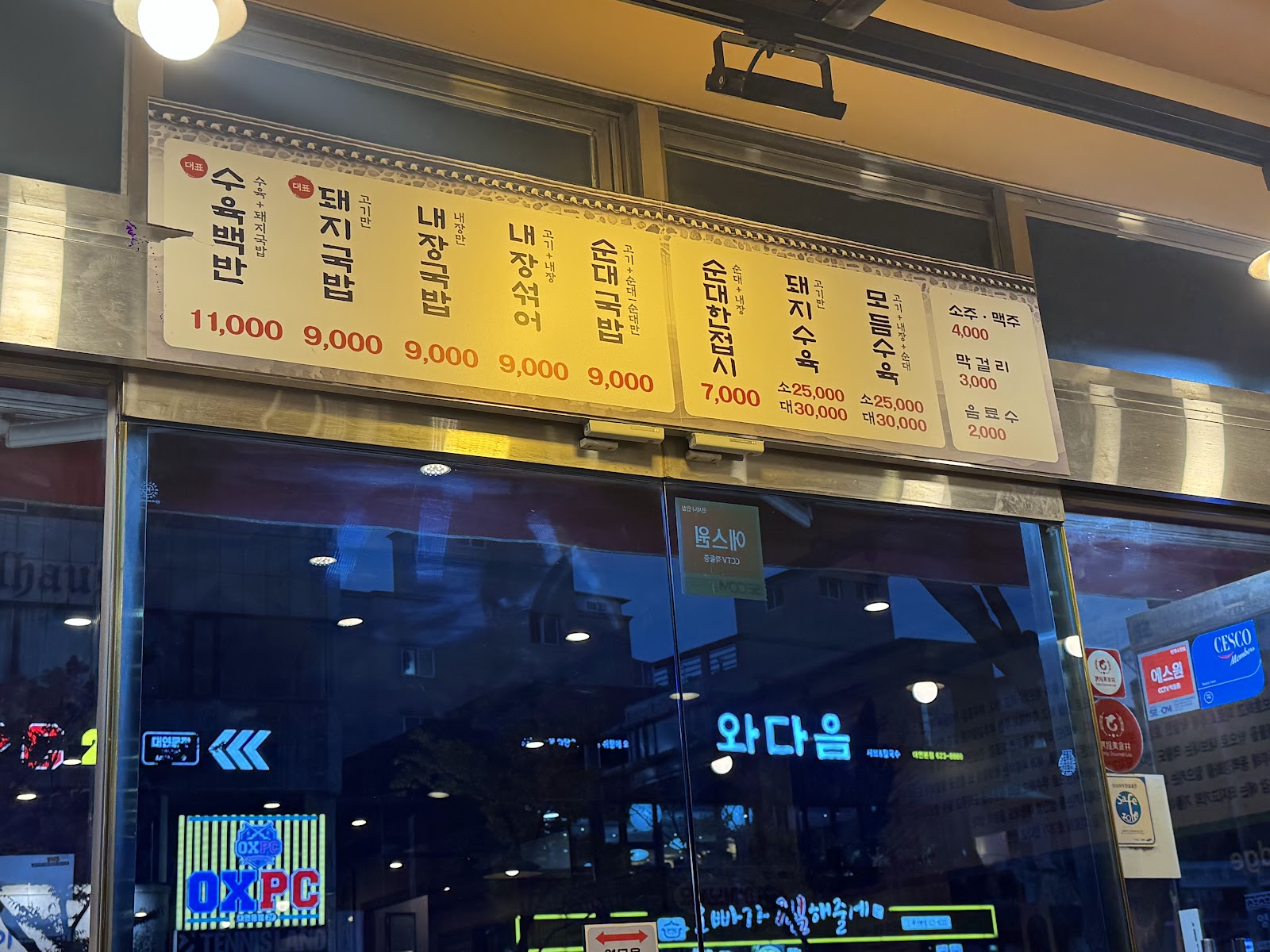
| Korean | Read as | What you get |
|---|---|---|
| 돼지국밥 | dwaeji gukbap | Sliced pork only. Order this if it’s your first time. |
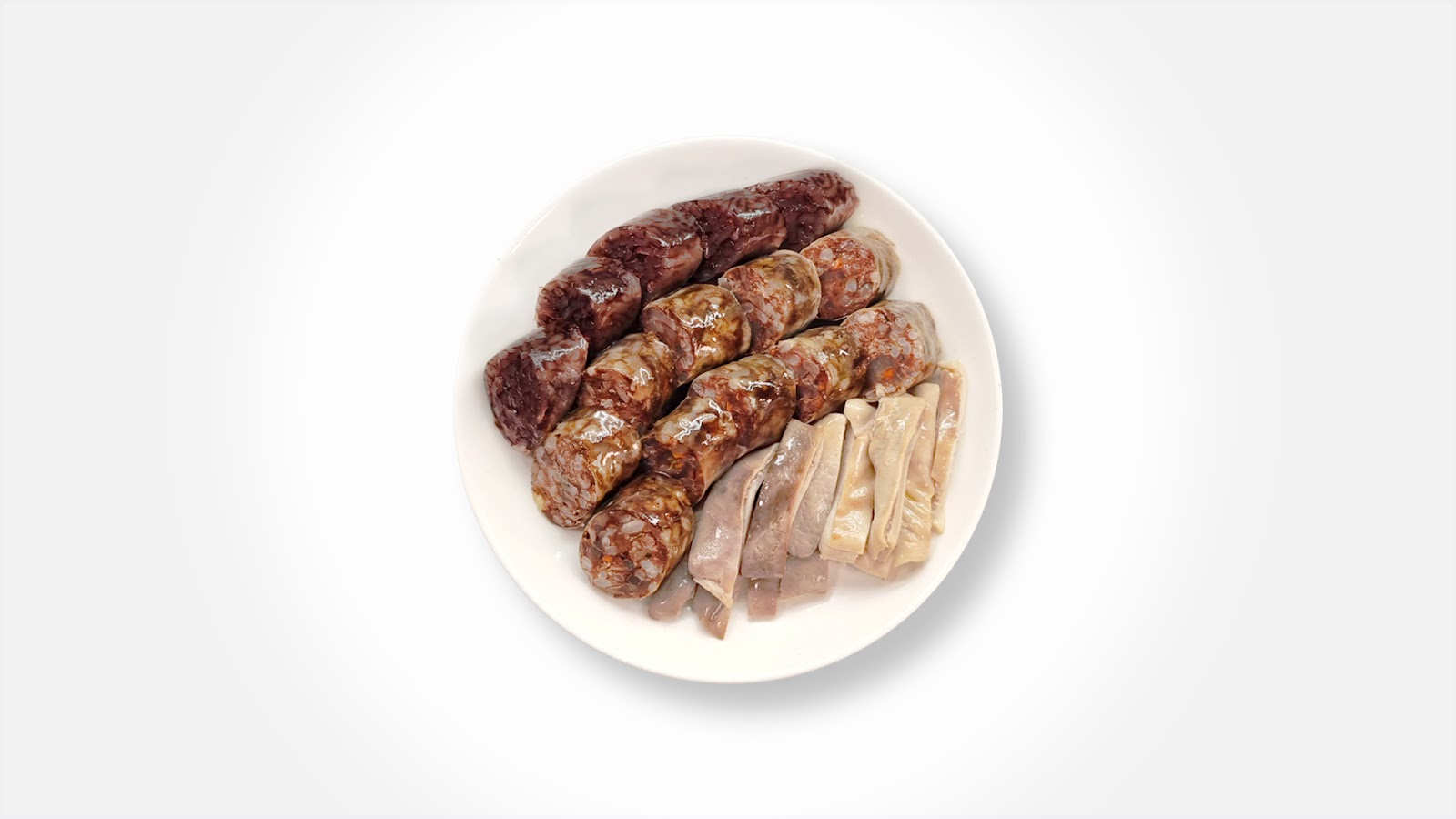
| 내장국밥 | naejang gukbap | Offal only. Intestines and organ meat. Strong flavour. |
| 섞어국밥 | seokkeo gukbap | Mixed. Pork and offal together. |
| 순대국밥 | sundae gukbap | With Korean blood sausage. |
| 수육백반 | suyuk baekban | A plate of boiled pork plus a bowl of soup. More food, more money. |
| 돼지수육 | dwaeji suyuk | A large sharing plate of boiled pork. For two or more, usually with drinks. |
The one to watch is 섞어. It reads like “mixed” in a harmless way and it means offal is going in your bowl. If you don’t want that, point at 돼지국밥 and you’re safe.
If you can’t read any of it, say “dwaeji gukbap” out loud and hold up fingers for how many. It works every time.
🥬 The side dishes are free and unlimited
A gukbap table comes with kimchi, pickled radish, sometimes chives in sauce, sometimes a raw onion and green chilli plate. None of it costs extra and you can ask for more.
The kimchi at a gukbap shop is usually the sharper, more fermented kind, which is deliberate. It cuts through the fat of the broth. Eat them together rather than treating the kimchi as a side project.
Refills are normal. Catch someone’s eye and point at the empty dish. Nobody will think it’s strange.
🕐 When Busan actually eats this
Gukbap is not a special-occasion meal and treating it like one misses the point.
- Breakfast. Plenty of shops do their heaviest trade before 9am. Hot soup as a first meal is normal here in a way it isn’t in most countries.
- Lunch on a working day. Fast, filling, under ₩10,000. This is the bulk of it.
- After drinking. Salty broth at 2am is the standard repair job, which is why so many shops never close.
- Winter, constantly. Busan winters are windy rather than freezing, and a bowl of this is the correct response.
If you want to see the dish in its natural setting rather than as a tourist stop, go at 8am on a weekday. The room will be quiet, mostly men eating alone before work, and finished in ten minutes.
What to drink with it
Soju is the reflex answer and it works. Makgeolli, the cloudy rice wine, is the other common pairing and usually cheaper at around ₩3,000.
Fair warning from a Google review of one famous shop: the very cheap makgeolli at some gukbap places is rough. If you’re trying it for the first time, this may not be where to do it.
💰 What it costs
This is one of the cheapest proper meals in Korea, which is a large part of why it’s the city’s default.
| Dish | Typical price (2026) |
|---|---|
| 돼지국밥 (pork soup with rice) | ₩9,000 to ₩12,000 |
| 내장 / 섞어 / 순대국밥 | Usually the same as the plain version |
| 수육백반 (boiled pork plate + soup) | around ₩11,000 |
| 돼지수육 (sharing plate) | ₩25,000 small, ₩30,000 large |
| Soju or beer | ₩4,000 |
| Makgeolli | ₩3,000 |
Prices vary a little by neighbourhood. A famous shop in Seomyeon and a quiet one in a residential district will be within a thousand won of each other, which is not the case with most food in Korea.
Cards are accepted almost everywhere. A few very old shops still prefer cash, so having ₩20,000 on you removes the question.
🍜 How it differs from the other Korean soups
Korea has a lot of white-broth meat soups and they run together fast when you’re new. The short version:
| Dish | Broth from | Comes with | Where |
|---|---|---|---|
| 돼지국밥 Dwaeji gukbap | Pork bone | Sliced pork, rice | Busan’s own |
| 설렁탕 Seolleongtang | Beef bone | Brisket, noodles, rice | Seoul, nationwide |
| 곰탕 Gomtang | Beef bone and meat | Beef, rice | Nationwide |
| 순대국 Sundaeguk | Pork bone | Blood sausage, offal | Nationwide |
The family resemblance is real. All of them arrive pale and under-seasoned and expect you to fix them at the table.
What makes the Busan version distinct is how light the broth is kept, and the salted shrimp. Seolleongtang gets salt and spring onion. Dwaeji gukbap gets 새우젓, and that one ingredient is most of the difference in flavour.
📍 Where to eat it
There are hundreds of gukbap shops in Busan and arguing about the best one is a local sport. Two that are easy for a visitor to get to and consistently busy with locals:
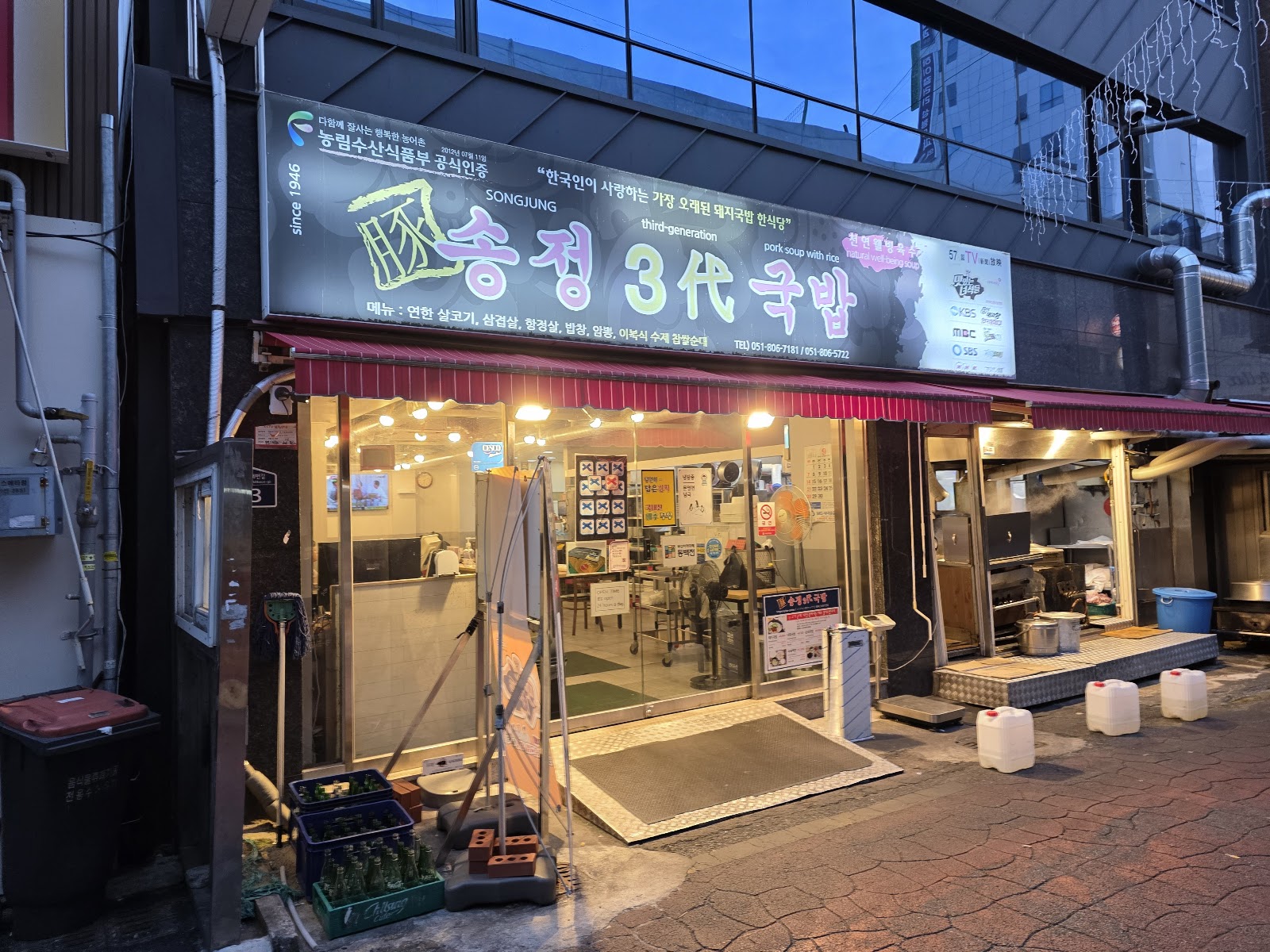
Songjeong 3(sam)dae Gukbap — Seomyeon
- Where: 33 Seomyeon-ro 68beon-gil, Busanjin-gu. Walkable from Seomyeon Station.
- Hours: 24 hours, every day.
- Rating: 4.1 from over 4,400 Google reviews.
- Why here: open since 1946 and now run by the third generation. The broth is on the light side, which lets the pork come through. Being open around the clock makes it the obvious answer after a late night.
Worth knowing: because it’s famous, it draws visitors as well as locals, and a few people find the broth too mild. That’s the seasoning tray talking. Use it.
Ssangdungi Dwaeji Gukbap — Nam-gu
- Where: 35-1 UN pyeonghwa-ro, Nam-gu. A few blocks from Daeyeon Station.
- Hours: 9am to 10pm, every day.
- Rating: 4.0 from over 2,500 Google reviews.
- Why here: away from the tourist strips and full of people who work nearby. The kimchi and pickle spread is generous and endlessly refilled.
Or just walk into one
Genuinely. Look for a shop with a steamed-up window, older customers, and a large pot visible from the street. Busan does not really have bad gukbap. It has gukbap you haven’t seasoned yet.
❓ Quick answers
What is dwaeji gukbap?
A Busan pork bone broth soup served with sliced boiled pork and rice. Mild by default, seasoned at the table by the person eating it.
Is dwaeji gukbap spicy?
Not unless you make it spicy. It arrives with no chilli in it at all. The red paste on the table is optional.
Why does it taste bland?
Because you haven’t seasoned it yet. Add salted shrimp (새우젓) a little at a time, plus a big handful of chives. This is the intended way to eat it, not a workaround.
Is it good for breakfast?
It’s one of the standard breakfasts in Busan. Plenty of shops are busiest before 9am.
Can I eat it if I don’t like offal?
Yes. Order 돼지국밥, which is pork only. Avoid 내장 and 섞어.
What does it cost?
Around ₩9,000 to ₩12,000 for a full bowl with rice and unlimited side dishes.
Is there a vegetarian version?
No. The entire dish is pork bone broth. This is not a meal to adapt.
📌 The short version
- What: pork bone broth, sliced pork, rice. Busan’s default meal.
- Cost: ₩9,000 to ₩12,000. Side dishes free and unlimited.
- Order: 돼지국밥 for pork only. Avoid 섞어 unless you want offal.
- Season it yourself. Salted shrimp (새우젓) first, then chives, then chilli paste if you want heat.
- Not spicy until you make it spicy.
- Where: Songjeong 3dae in Seomyeon (24h) or Ssangdungi near Daeyeon Station.
Taste it plain first so you know what you’re adjusting. Then fix it, and understand why a city of three million people eats this at every hour of the day. 🇰🇷