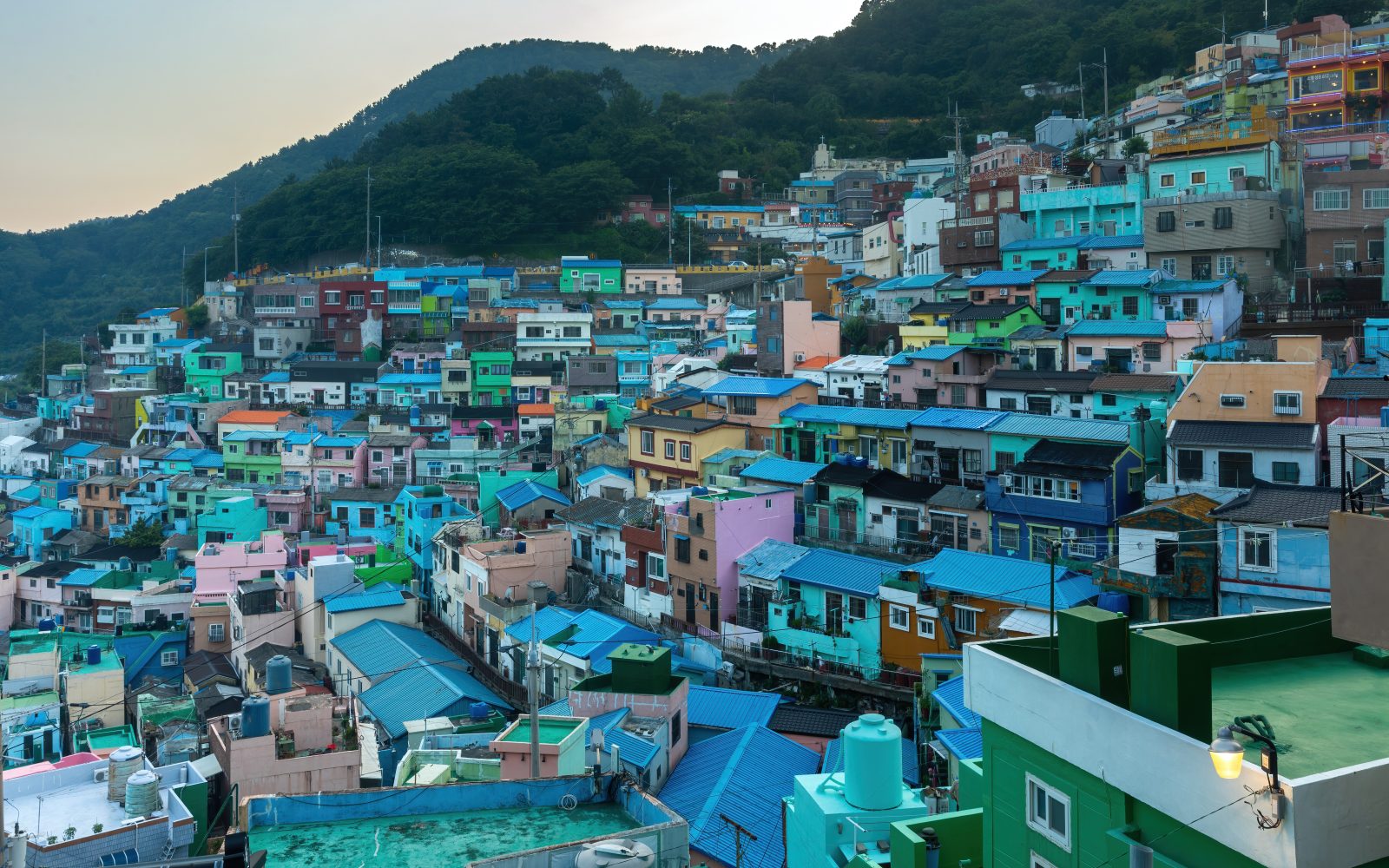
You’ve seen the photo. Pastel houses stacked up a hillside in blue, yellow and mint, row behind row, running down toward the water. It’s on the cover of every Busan guidebook and it’s the reason most people put Gamcheon on the list.
Here’s what the photo leaves out. The hill is steep enough that the stairs have handrails. About 5,600 people live up there and use those stairs to carry groceries home. And by noon on a Saturday you’ll be queuing twenty minutes for one photo with a small bronze statue.
None of that is a reason to skip it. It’s a reason to go early and know what you’re walking into. 🙂
🎨 Why the houses are painted
Gamcheon started as somewhere to put people who had nowhere else to go.
When the Korean War pushed refugees south in the early 1950s, Busan took in far more people than it had room for. Families built shacks out of scrap wood and corrugated iron on the mountainside, on land nobody else wanted because it was too steep to build on properly. A religious community called Taegeukdo settled a large share of them here, which is why the houses climb in those strange orderly rows instead of sprawling.
It stayed poor for the next fifty years. Locals called it a slum and meant it literally.
Then in 2009 the city ran a village art project. Art students, local artists and residents painted the houses together, put murals up the staircases, and stuck sculptures on the rooftops. The idea was to give a dying neighbourhood a reason for people to come.
It worked more than anyone planned. Last year 2.76 million people came.
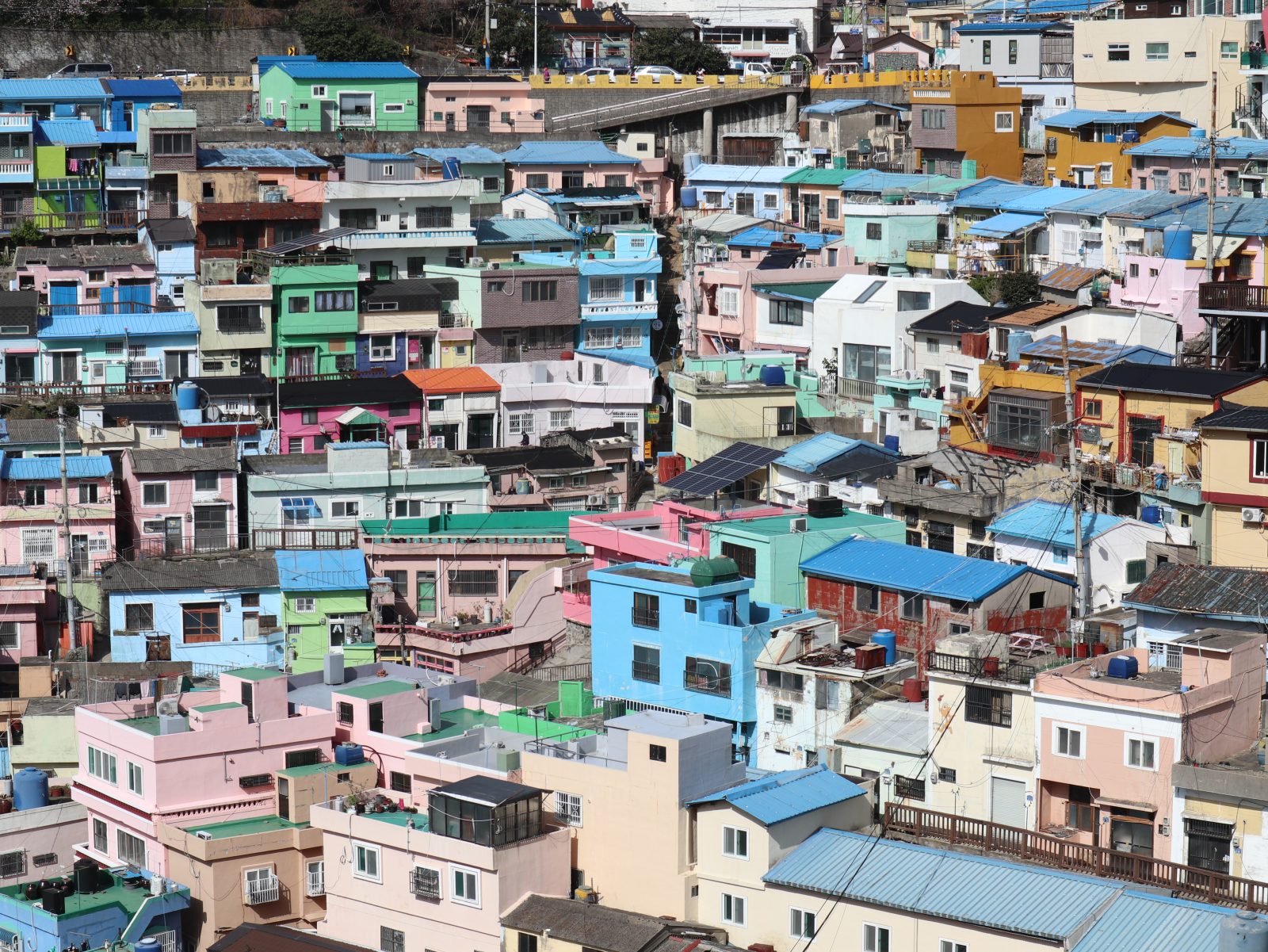
Walk it now and you can still read the original village underneath the paint. The houses are small because refugee housing was small. They’re stepped so that each row doesn’t block the light from the row behind. The alleys are narrow because they were footpaths first and never meant for cars.
🚇 How to get there
There’s no ticket booth and no gate. You walk in off the street.
From Busan Station or the city centre
- Take Line 1 to Toseong Station and come out of Exit 6.
- Walk straight, then turn right. You’re looking for a small bus stop in front of the Pusan National University Hospital Cancer Centre.
- Get the green village bus (마을버스): Saha 1-1, Seogu 2 or Seogu 2-2. Any of the three works.
- Ride 10 to 15 minutes and get off at 감천초등학교 / 감천문화마을 (Gamcheon Elementary School).
- Walk back about 30 metres the way the bus came, then turn left. That’s the entrance.
From Busan Station the whole thing runs around 40 minutes and costs under ₩3,000 each way. 🚌
From Haeundae
Budget an hour on the subway. Line 2 to Seomyeon, change to Line 1, ride to Toseong, then the bus as above. It’s a long ride for a two hour stop, so pair it with something else on the west side of the city (see below).
By taxi
Faster and not expensive if you’re splitting it two or three ways. Show the driver 감천문화마을 written down. Traffic on the hill road gets slow on weekends, so the bus sometimes wins anyway.
Worth knowing: the bus does all the climbing. If you walk up from Toseong you’ll arrive at the entrance already tired, and the village itself is the part with the stairs.
⏰ When to go, and why it matters more here
Weekday morning between 9 and 11. If you take one thing from this page, take that.
Three reasons. The tour buses start arriving around late morning, so before 11 you get alleys that are actually quiet. The light comes across the houses at that hour instead of straight down, which is what makes the colours look like they do in the photos. And the queue for the Little Prince statue is still short.
By midday that queue runs down the street. Weekend afternoons and Korean public holidays are the worst version of the place.
Season by season
- Spring (Apr to Jun) and autumn (Sep to Nov) are the easy answer. Mild, clear, comfortable for stairs.
- Summer is hot and humid and the village has almost no shade. If you come in August, come at 9am and bring water.
- Winter is cold and windy on an exposed hillside, but the crowds thin out and the light is sharp. Underrated if you don’t mind a jacket.
Sunset is beautiful and also the busiest hour of the day. Pick one.
🗺️ What’s actually up there
Gamcheon is a maze and it’s easy to wander for an hour without finding the things you came for. A few that are worth aiming at:
The stamp map
The information centre by the entrance sells a village map for ₩2,000. It marks the murals and viewpoints, and you collect a stamp at each one.
It looks like a children’s activity and it is. It’s also the best ₩2,000 you’ll spend here, because it’s the only thing standing between you and forty minutes of walking in a loop past the same blue house.
The Little Prince and the Fox
Two small bronze figures sitting on a wall with the whole village behind them. It’s the shot everyone wants and the queue reflects that.
There’s a second Little Prince at Byeolmaru Observatory, further along, and the wait there is usually a fraction of the main one. Same view, most of the same photo, a lot less standing around. 📷
The little museums
A handful of tiny exhibition houses are scattered through the village, most of them a single room in a converted home. A few are free, a few charge ₩1,000 or ₩2,000. The one about the village’s refugee history is the one to prioritise if you only do one.
Rooftop cafés
Several houses near the entrance have been converted into cafés with rooftop seating over the village. The coffee is average and the view is not. Sit down for twenty minutes before you start the descent, because you’ll want the break later and there’s less up top than you’d think.
👟 About the climb (people underestimate this)
The village goes down from the entrance. Which means you have to come back up.
The main route is paved and has railings. It’s fine. The problem is that the good photos are all in the side alleys, and those are narrow stone steps, uneven, sometimes wet, occasionally with a step that’s twice the height of the one before it.
Sandals will punish you. Smooth-soled shoes will punish you faster. 😅
If stairs are difficult
You can still do this. The top section near the entrance holds the main viewpoint, the information centre, the shops and most of the cafés, and it’s close to flat.
You’ll see the view that’s on the postcards without descending at all. The full loop is roughly 90 minutes of up and down, and skipping it costs you less than you’d expect.
Time to allow: 2 hours for the main sights. 2.5 if you want both viewpoints, the queue, and a coffee. Longer than that and you’re just walking the same alleys twice.
🤫 One thing worth reading before you go
Gamcheon is a neighbourhood before it’s an attraction, and the numbers show what’s been happening to it.
In 2012, 9,677 people lived here. By the end of 2023, 5,668 did. Roughly a quarter of the people still there are over 65. In the same period visitor numbers climbed past 2.7 million a year.
The district office has started restricting access to the most residential lanes between 9am and 6pm. The complaints behind that are ordinary and repetitive: noise in the alleys at night, litter, cars blocking narrow roads, and people photographing through windows into other people’s kitchens.
Being a good guest here costs nothing and takes no effort:
- Keep your voice down in the alleys. Sound carries straight into open windows.
- Don’t photograph into homes, and respect the signs where residents have asked not to be photographed.
- Take your cup with you. Bins are scarce on purpose.
- Don’t sit on doorsteps or private stairs for photos.
That’s the whole list. ☕
📸 Where the photos actually are
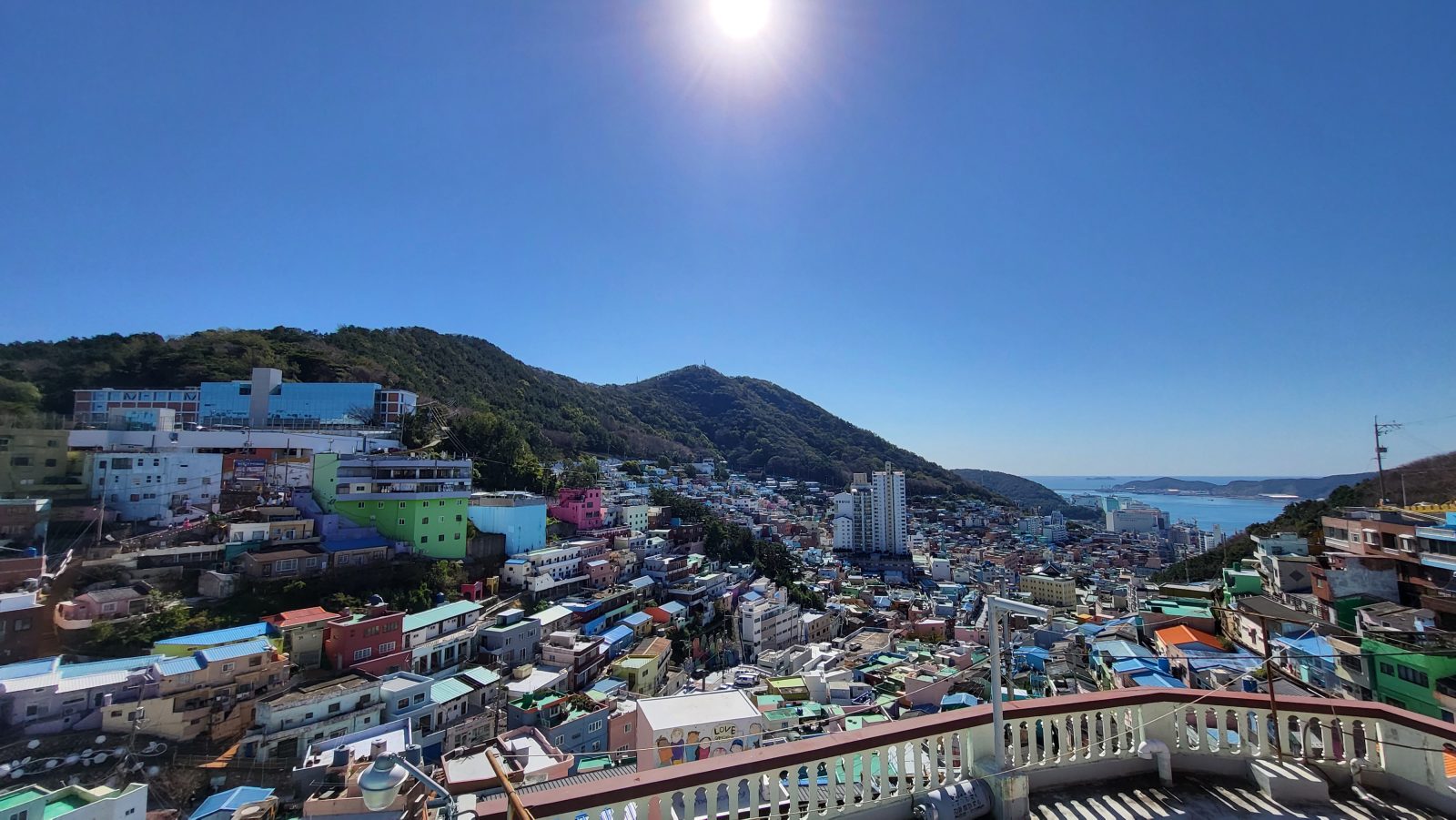
The classic wide shot is from the observation deck near the entrance, looking down over the roofs toward the sea. Morning light, standing to the left side of the deck.
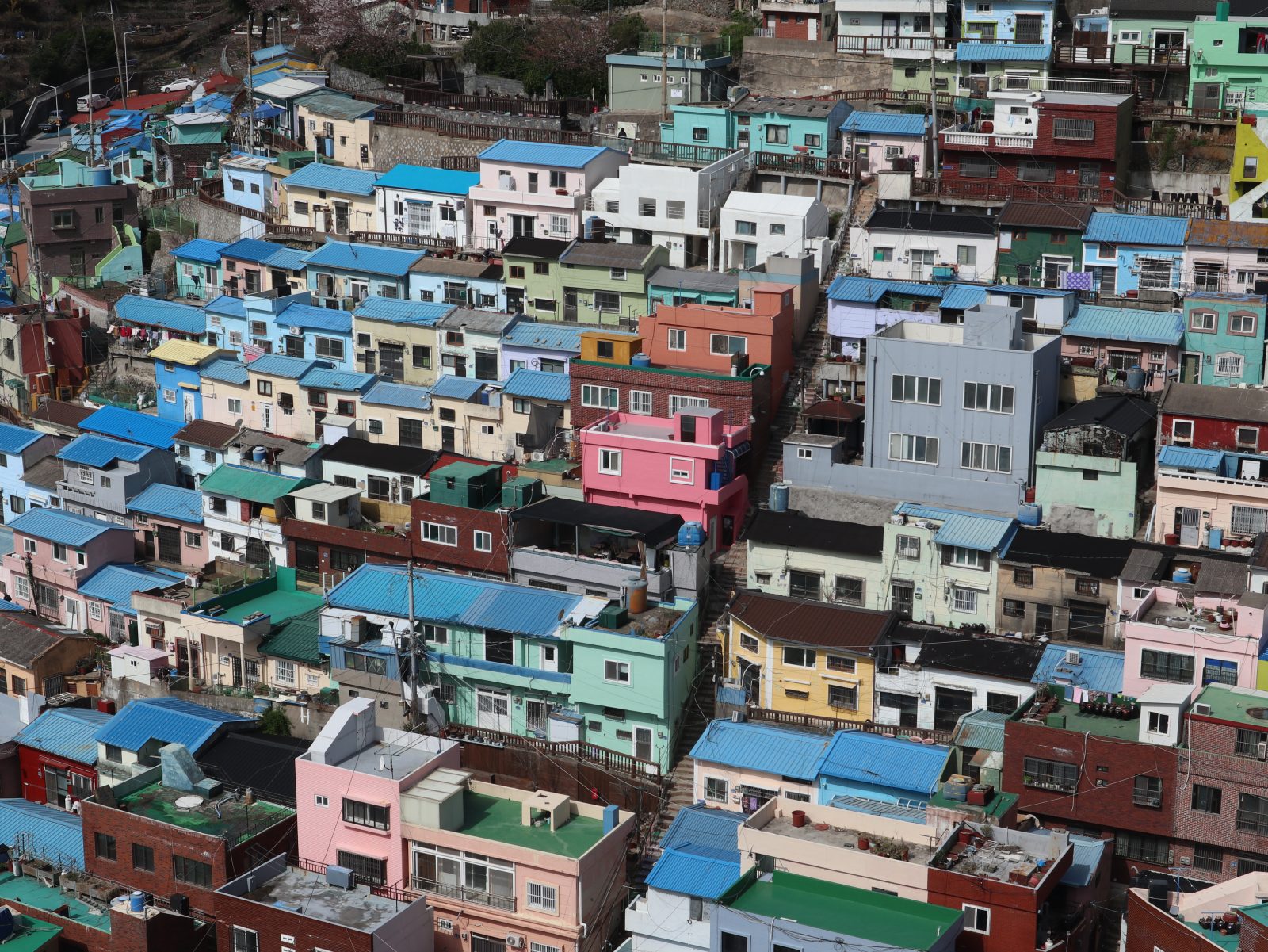
The second angle worth having is from the lower alleys looking back up the hill, which shows how steeply the houses are stacked. The wide shot flattens that out completely.
Skip the drone. Flying over a residential area here will get you talked to, and the village is dense enough that there’s nowhere sensible to launch from anyway.
🍜 What to pair it with
Gamcheon is a two hour stop and it’s on the west side of Busan, so plan the rest of the day around that rather than trekking back across the city.
Jagalchi Market
Korea’s biggest seafood market, back toward Toseong Station. Pick something downstairs, they cook it upstairs. Go hungry.
Gukje Market and BIFF Square
Ten minutes from Jagalchi on foot. This is where you find ssiat hotteok, the fried sugar pancake split open and packed with sunflower and pumpkin seeds. Busan’s version is the one everyone else copies.
Give it a full minute to cool before biting in. The syrup inside comes out of the fryer hot enough to hurt, and everybody learns this exactly once. 🥞
Songdo Beach and the cable car
A short taxi from Gamcheon. The Songdo Marine Cable Car runs out over the water and some cabins have glass floors. Better in clear weather, pointless in fog.
❓ Quick answers
Is Gamcheon Culture Village free?
Yes. No admission, no gate. You’ll only spend money if you buy the stamp map (₩2,000), enter one of the small museums (₩1,000 to ₩2,000), or stop for coffee.
How long do I need?
Two hours covers it comfortably. Two and a half if you want both Little Prince spots and a sit-down break.
Can I go with a stroller or a wheelchair?
The top section near the entrance is flat and accessible. The rest of the village is stairs, and there’s no way around that. Plan for the viewpoint rather than the full loop.
What time does it close?
The village is a residential neighbourhood, so the streets themselves never close. Shops, cafés and museums generally run 9am to 6pm, and the residential lanes are restricted outside those hours.
Is it worth it if I only have two days in Busan?
Yes, if you pair it with Jagalchi and Gukje Market and treat the west side as one half-day block. Doing it as a standalone trip from Haeundae eats most of an afternoon in transit.
Rain?
The stone steps get genuinely slippery and the colours go flat. If your schedule allows a swap, swap it.
📌 The short version
- Cost: free. Stamp map ₩2,000 from the info centre, and get it.
- Getting there: Line 1 to Toseong, Exit 6, green bus Saha 1-1 / Seogu 2 / 2-2.
- When: weekday, before 11am.
- Time needed: 2 hours, 2.5 with both viewpoints.
- Shoes: proper ones. It’s stairs the entire way down and back up.
- Skip the queue: second Little Prince statue at Byeolmaru Observatory.
- Pair with: Jagalchi Market and ssiat hotteok at BIFF Square.
Go early, walk slowly, keep your voice down in the alleys, and it’s one of the best mornings you’ll have in Busan. 🇰🇷